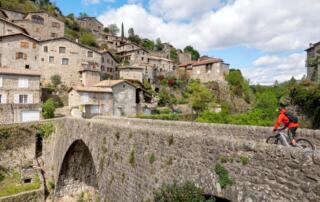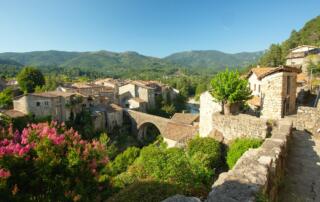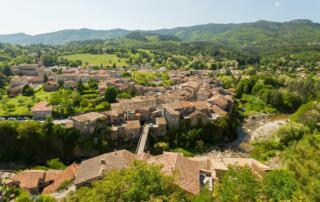
Jaujac, Ardèche
Opening : Wednesday 5 August 2026 between 10 am and 12 pm and between 2 pm and 5 pm.
A special open day at Château du Bruget. A few parking spaces are available on site; otherwise, it is within walking distance from the village of Jaujac (1 km).
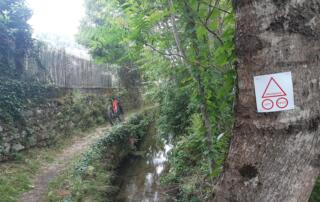
Parking spaces are available free of charge, but, weather permitting, it is a pleasure to walk up from the village of Jaujac (1 km via the shortest marked path – see the walking map).
Information on road and foot access
We are sorry, but the upper floors are accessed via a spiral staircase which cannot be used independently by visitors with mobility impairments.
If assistance is required, please do not hesitate to ask the guides or other visitors.
Smoking is prohibited during the visit.
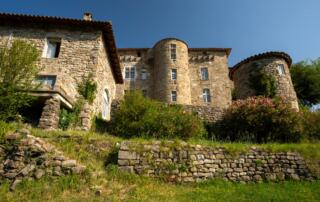
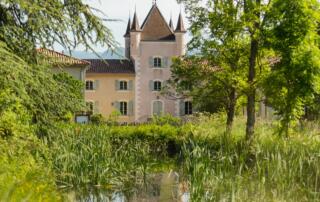
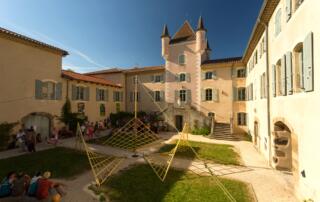
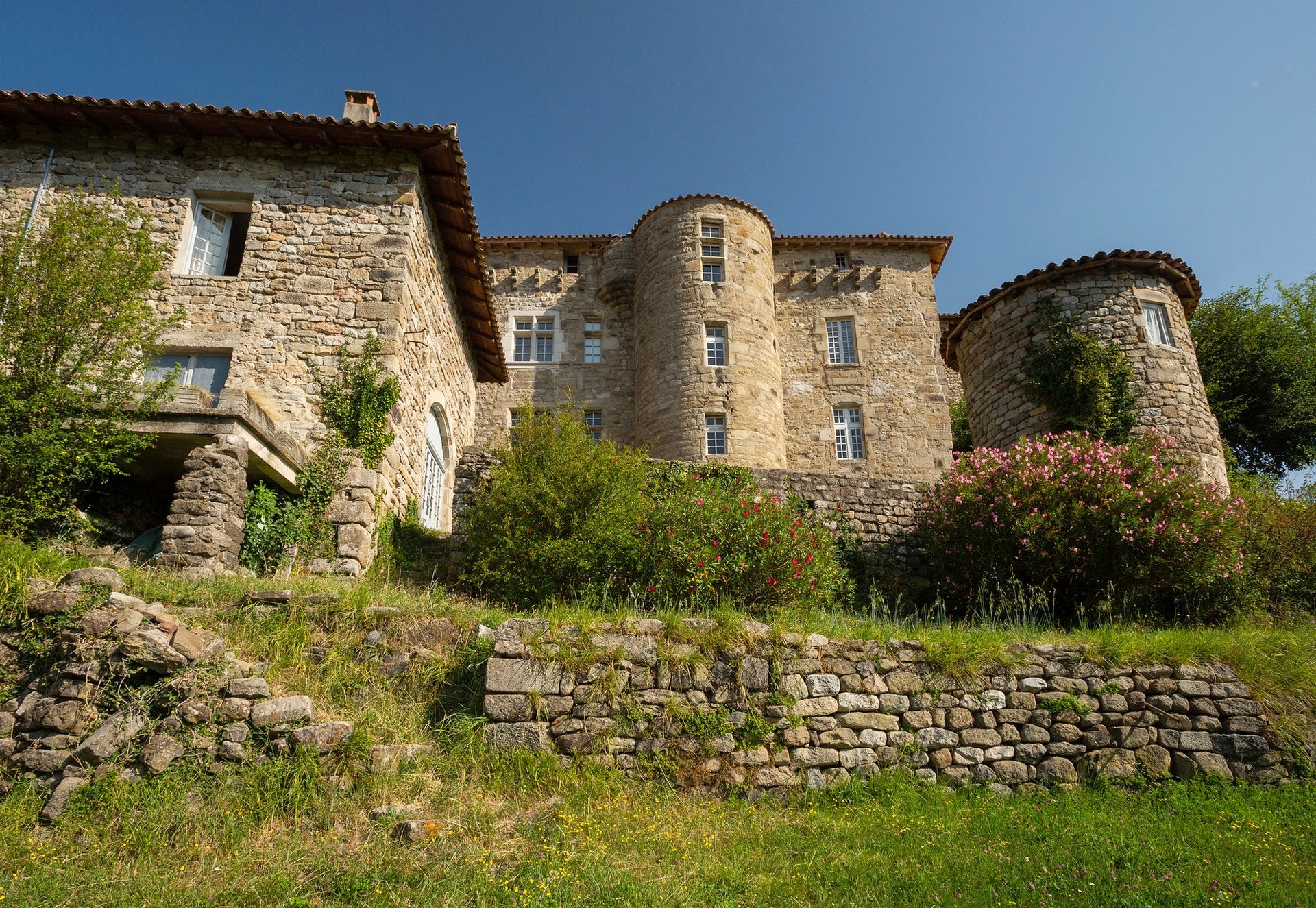
Le Bruget is a house maintained by families with a passion for old buildings, who strive to preserve it for their own enjoyment and yours. Construction of this building was completed at the end of the 16th century. It was listed in the supplementary inventory of historic monuments in 1954, in particular to preserve its beautiful architectural features, such as its five monumental fireplaces and the toric vault crowning the spiral staircase.
The château has been in the same family for two generations. The present château is thought to have been built by the de La Tour de Beins family in the 17th century, on top of older ruins. It then passed to the de Launay family.
Emmanuel de Launay, the famous Count of Antraigues, sold it in 1780 to a lawyer from Jaujac, Aimé Monteil. Confiscated as national property during the Revolution, it was converted into a farmhouse and saved from ruin in the 1930s by Georges Balaÿ and his two sisters. It underwent restoration work at that time: consolidation of the façade, repair of the windows, and reconstruction of the large fireplace. The château occupies a commanding position on the mountainside overlooking the valley. Its ground plan is identical to that of Hautsegur Castle (located in the neighbouring commune of Meyras): a rectangle flanked by two towers to the north and, to the south, a round tower set into the façade housing the staircase. This tower may be older than the south façade and date from the 14th century, like the west façade and the north-west corner tower. The south façade, facing the valley, features several rectangular windows and arrow slits. A stone engraved with a coat of arms was found in 1985 above the entrance door; it is believed to be the arms of the La Tour de Beins family. Numerous Masonic symbols are scattered throughout the building. (text by Bernard De Brion).
- Parking
- Pets accepted: No
- Pets allowed (supplementary payment): Unknown
- Not accessible in a wheelchair
- French